Robotic Identification of Airflow Bypass in Containment Systems
Robots map hidden airflow leaks that cost data centers millions in wasted cooling energy.
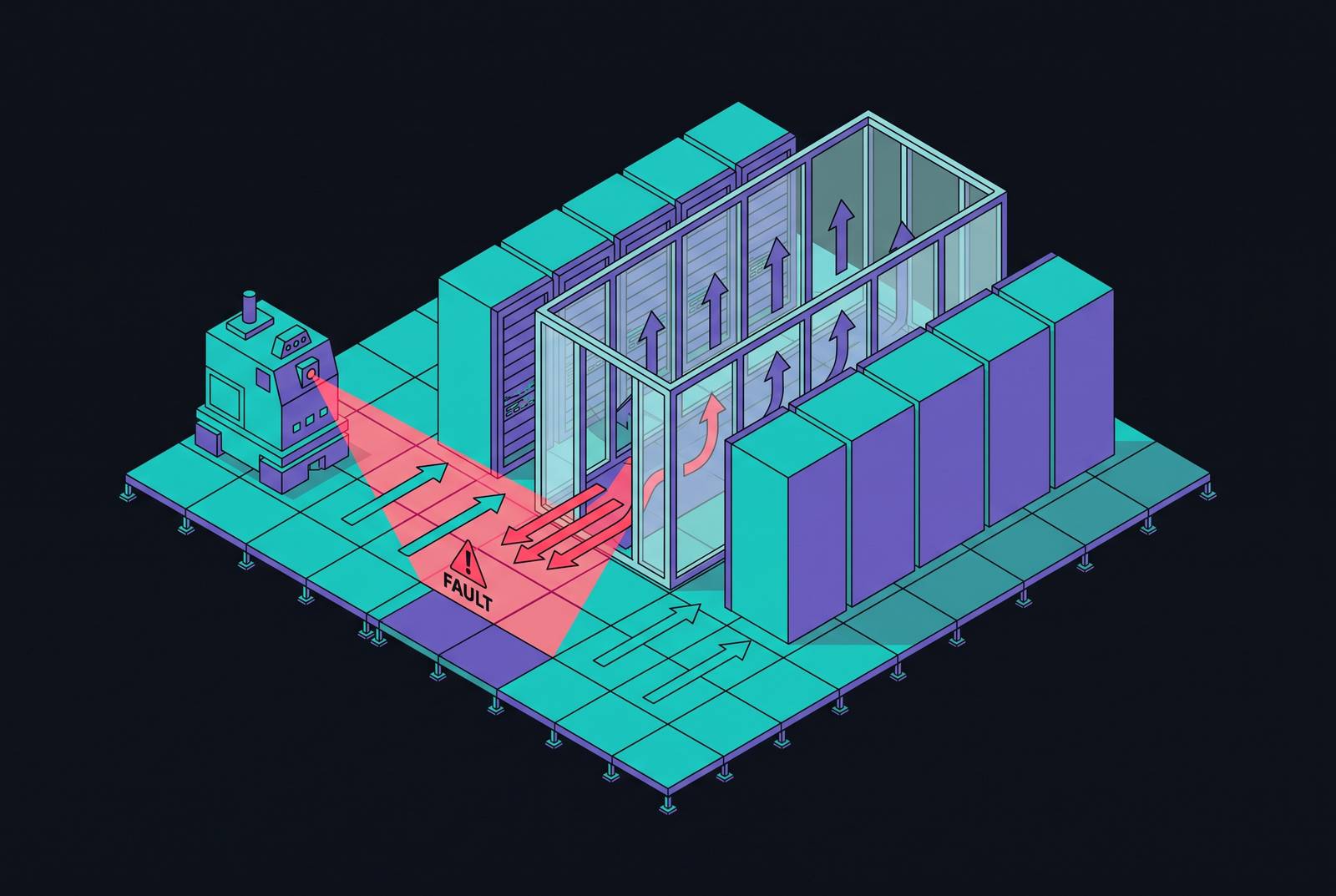
Airflow bypass is conditioned supply air that returns to a cooling unit without ever touching IT equipment, a filter bank, or a controlled workspace. It does no work. Robotic platforms now carry pressure, thermal, and optical sensors into spaces no fixed sensor grid and no human inspector can reach, and turn what they collect into a map of exactly where a facility's containment breaks down.
The intended path is simple enough to sketch on a napkin: cold air enters a rack, moves through the equipment, comes out warm on the other side, and gets recooled. Bypass is any break from that loop, and it appears at the seams, not the surfaces. An open rack unit or a missing blanking panel lets exhaust air flow straight back to the inlets it just left. A raised floor with an unsealed cable cutout bleeds pressure into the room instead of pushing it up through the rack. Gaps at the top of an aisle or at its end let hot air spill back over a containment barrier built to stop it. Cabinet edges and floor penetrations without brush grommets or panel seals do the same thing on a smaller scale. Containment doesn't fail in the middle of a wall or a barrier. It fails at the transitions, the spots where one surface meets another and somebody forgot to seal the gap.
This isn't a data center problem alone. An AHU filter bank can show a bad differential-pressure reading at the unit level while giving no clue which individual filter is bypassing or sitting crooked in its frame. In pharmaceutical isolators, unidirectional airflow and a maintained pressure differential are what keep an ISO 14644-1 Class 5 environment clean, so a disruption there is a contamination event, not a line item on an energy bill. Cleanrooms operating under EU GMP Annex 1 treat undisturbed unidirectional airflow as a product's last line of defense, treating airflow integrity as a core element of design rather than an afterthought.
Why the bypass problem has grown more consequential
The waste here isn't a rounding error. Industry analysis of conventional legacy data centers has found that a large share of the air delivered by precision air conditioning units never reaches IT equipment, doing nothing but running up the utility bill.
That number matters more now because the energy stakes have grown. Data center energy consumption has been rising sharply, with forecasts pointing to continued significant growth over the coming years. Against that backdrop, the gap between average and best-in-class cooling stops being academic: the gap between average and best-in-class PUE remains wide across the industry. Most of that distance is airflow sitting on the table, recoverable once somebody finds where it's leaking.
AI workloads have squeezed the tolerance for that leakage down toward zero, and the industry has been slow to admit it. Standard hot-aisle/cold-aisle containment hits a practical ceiling at high rack densities, because past a certain point the delta-T across the rack becomes unmanageable unless the containment is close to airtight. A bypass path that cost almost nothing in efficiency at low rack density now eats directly into capacity a facility needs and doesn't have to spare. The same access problem shows up outside the data center: commercial building ductwork can lose a substantial share of conditioned air to inefficiencies that often go undetected for years, simply because nobody can get eyes on the duct run without tearing something open. Anyone still budgeting cooling capacity off nameplate ratings, without accounting for bypass, is planning against a number that was never real.
Why static sensors and manual inspection cannot find unreachable leaks
A differential pressure sensor mounted at the unit level tells an operator that something across a filter bank is off. It doesn't say which filter, out of dozens, is bypassing or sitting improperly seated in its track. Static sensing produces an average, and bypass is a spatial problem, not an average one. A single unsealed cable cutout in one rack row can leak conditioned air all day without ever moving a room-level sensor enough to trip an alarm.
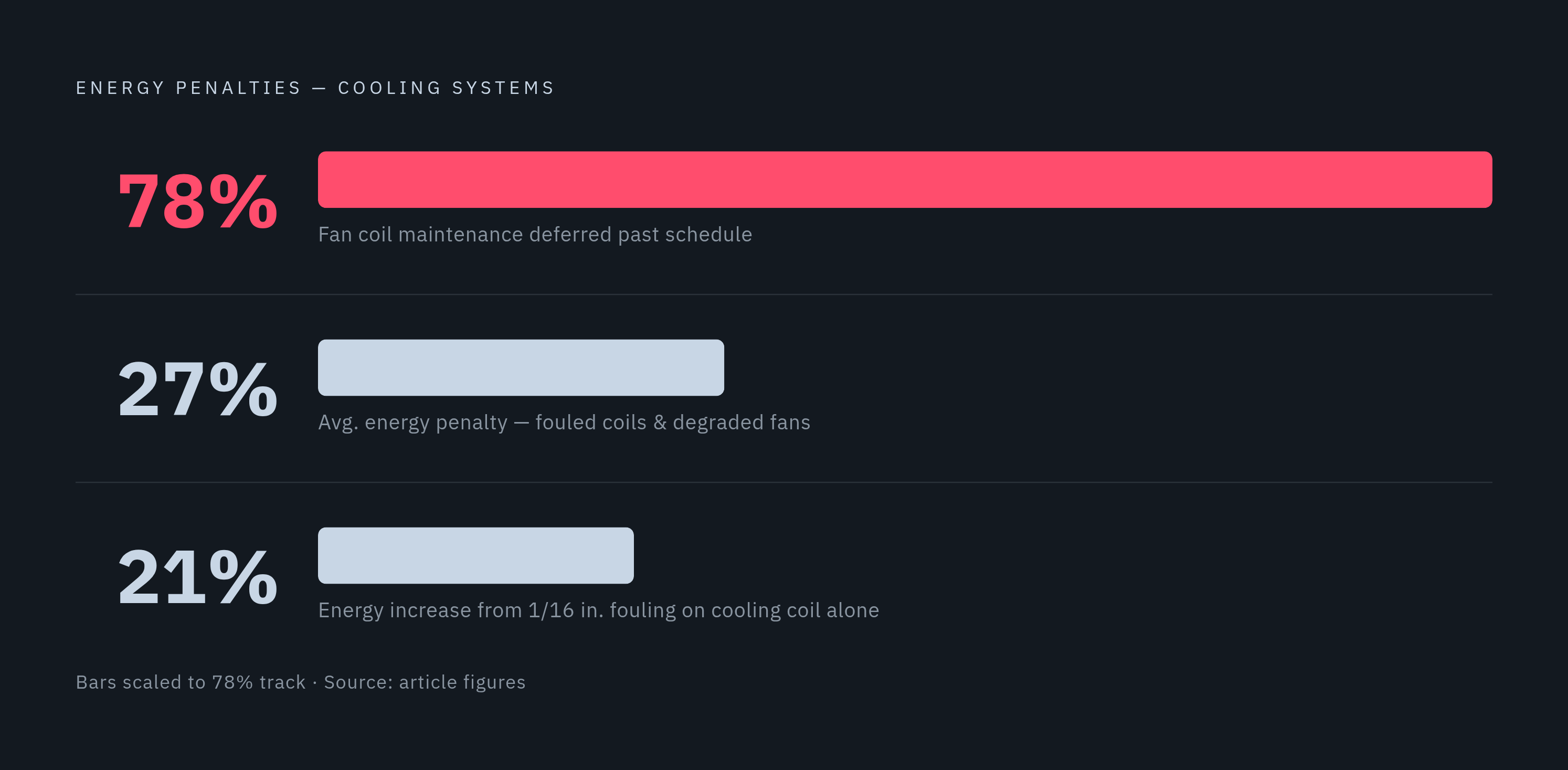
Manual inspection runs into three problems, and they stack. Access comes first: ductwork threads through ceilings, walls, and mechanical shafts that a person cannot physically enter without cutting an access panel or bringing in scaffolding. Safety follows close behind, since AHU plenums and underfloor spaces often call for lockout/tagout procedures, confined-space protocols, and an escort. A full manual AHU inspection, cycling through access, inspection, reassembly, and restart, tends to run around 3.5 hours of labor. Disruption is the third factor: shutting a unit down to inspect it interrupts whatever it's cooling, which is part of why an estimated 78% of fan coil maintenance gets pushed past its scheduled date. Getting to the unit costs more, in the moment, than the inspection is worth to whoever has to sign off on it.
A sampling bias produces all three, and no amount of diligence fixes it. Manual inspection is a spot check by definition. It captures conditions at the one moment and one location an inspector can physically reach, and that spot is rarely where the leak is worst. Treating a clean manual inspection as proof of a sealed system gets the logic backwards: it proves only that the one place someone looked, at the one moment they looked, happened to be fine.
How autonomous mobile platforms change what is detectable
A robot doesn't out-sense a fixed sensor from where the sensor happens to sit. It moves the sensor to every point in the containment geometry, and that turns a single scalar reading into a spatial dataset with real coverage. At each stop along its route, a robotic platform logs thermal imagery, airflow velocity, acoustic signatures, differential pressure, and ambient temperature and humidity together. Having all five side by side resolves ambiguities that any one of them alone would leave open. A thermal hotspot might be recirculation, or it might just be a sunbeam through a window. Adding an airflow velocity reading and a pressure delta at that same coordinate removes most of that ambiguity.
Because the route repeats, the same physical points get checked on the same schedule every time, and change over weeks or months becomes just as informative as any single day's reading. These platforms navigate using SLAM (simultaneous localization and mapping), building a spatial model of the containment geometry as they go, and that model becomes the coordinate system every sensor reading gets pinned to. A bypass location becomes a specific point on an actual floor plan instead of an abstract alarm on a dashboard, because the model ties it to real coordinates.
The main robotic platforms and what each can reach
Wheeled autonomous mobile robots (AMRs) handle patrol work in hot-aisle/cold-aisle configurations, moving through the aisles and, via ramp or lift, into underfloor plenums. They typically carry thermal cameras, acoustic sensors, and airflow measurement instruments alongside standard environmental sensors, running the same route on a fixed schedule for continuous thermal and visual checks and anomaly flagging. What they surface, more than anything, is the microclimate: rack-row-level swings in airflow, temperature, and humidity that a room-level sensor averages into invisibility.
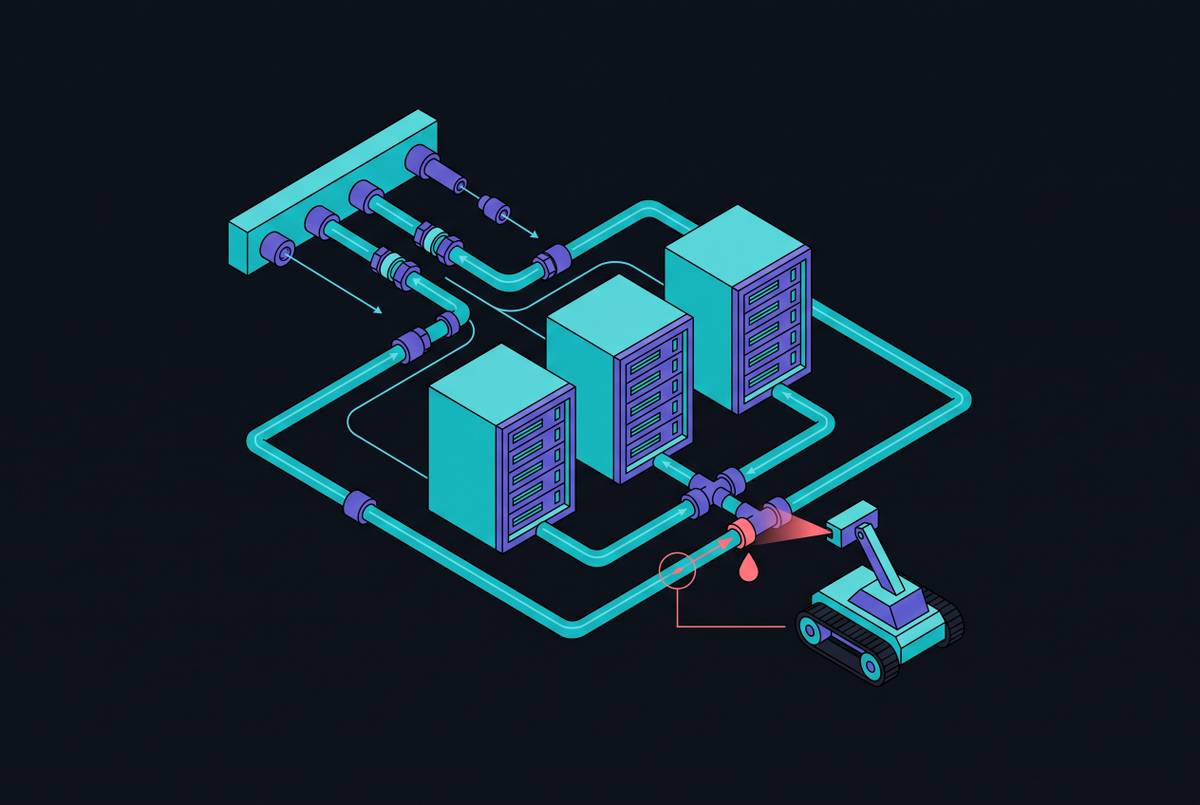
AHU plenum crawlers go somewhere AMRs generally don't: inside the air handling unit itself, sometimes while the fans are still running, working around vibration, high-velocity airflow, tight clearances between coil sections, and low light. From in there, they inspect coil condition, measure filter loading section by section across the entire bank (catching the individual bypassing or misseated filter a unit-level DP sensor can't localize), check belt tension, and read bearing vibration. Some measure actual damper blade position optically for outside air, return air, and exhaust dampers, comparing it against what the building automation system thinks it commanded. That comparison directly flags a stuck or drifted damper, a significant source of wasted energy and ventilation non-compliance in AHU systems. The stakes aren't small: fouled coils and degraded fans carry an average energy penalty around 27%, and something as thin as a 1/16-inch layer of fouling on a cooling coil can raise energy use by 21%. Thermal imaging from a crawler catches that fouling while the unit runs under full load, not after it's shut down for a scheduled teardown.
Duct crawlers are smaller, wheeled, and built to go where a person never could, running straight down a supply or return duct while carrying a 360-degree camera, a thermal camera, and a gas detector for VOCs. They cover every linear foot of a duct run on their own, erasing the access problem that keeps human inspectors out. In plenum mode, the same platform shifts its attention to unsealed penetrations, fire damper condition, contamination sources, filter bypass pathways, and the structural condition of the plenum barrier itself.
Quadruped robots earn their keep on terrain that defeats wheels: stairs, uneven floors, mixed indoor-outdoor paths. Industrial-grade thermal cameras mounted on these platforms carry sufficient precision to map how a hot spot builds from recirculation over time. The industrial quadruped market was valued above $2 billion in 2025 and is growing at roughly 20% a year, with inspection and monitoring work making up around 36% of deployments. Adoption spans a range of industries with demanding inspection requirements, including data centers, industrial facilities, and critical infrastructure.
Picking the wrong platform for the geometry makes the inspection tell you less than a spot check would. A quadruped in an underfloor plenum wastes its legs on a job wheels do better; a wheeled robot sent into ductwork simply doesn't fit. Matching platform to space is most of the job, and it's the decision most facilities get wrong first. It's most of the job, and it's the decision most facilities get wrong first.
The sensor stack that turns platform mobility into bypass maps
Thermal and infrared cameras, FLIR being the name most often attached to this gear, catch the hotspots that hot-air recirculation and cold-air bypass leave behind. A leak's visual signature is a temperature anomaly, and the camera resolves it in space rather than as a single averaged number.
Hot-wire anemometers measure airflow velocity directly at rack inlets and containment boundaries, which turns a suspected bypass into a quantified one: not just that air is escaping, but how much. Pressure sensing carried on the robot can catch imbalances between zones that mark an active leak path, and because the reading is tied to the robot's logged position at that instant, the imbalance registers as a point in space rather than a number with no address. LiDAR SLAM handles navigation and also builds the geometric map every other sensor reading gets registered against, so it does double duty across the whole stack.
None of these sensors mean much alone. A thermal camera by itself gives a picture; a diagnosis takes more than that. Stacking the readings at the same coordinate turns the picture into a measurement.
AI and machine learning extending detection from snapshot to prediction
A patrol's raw sensor output is just the input. The value comes from comparing it against a baseline performance envelope and flagging what doesn't fit. Thermal pattern analysis, vibration signature comparison, and coil-condition scoring models catch a deviation weeks before it crosses an alarm threshold, with delta-T trending in particular surfacing degradation early enough to schedule a fix instead of reacting to a failure.
One patented approach, US Patent 11,049,052, lays out the logic end to end. Once an energy penalty tied to an airflow deficiency turns up, the system checks it against a predefined maximum acceptable threshold. If that threshold is breached, it checks the component's installation correctness, notifies an operator, and can start corrective action on its own. Detection, in that design, doesn't stop at a flag on a screen. It closes the loop through diagnosis and into remediation.
Research is pushing the same logic further upstream. A University of Maryland team built a machine learning framework trained on porous-media computational fluid dynamics simulations to predict changes in airflow velocity that affect heat exchanger performance. A model trained entirely on simulation can generalize to real-system bypass behavior without needing a physical sensor at every point in the system. That's where the field is heading: fewer sensors doing more inference, catching a leak while it's still forming instead of after it's already costing money.