Robotic Arm Deployments for Physical Server Hardware Swaps
Data centers turn to robots to fill a critical staffing shortage in hardware maintenance.
The United States runs 4,165 data centers as of 2025, more than eight times the number in the United Kingdom, which comes in second at 499. The five largest hyperscalers plan to spend somewhere between $660 billion and $690 billion on infrastructure in 2026 alone, most of it aimed at AI compute, data centers, and the networking gear that ties it all together. None of that capital does much good without people to rack the servers, replace the failed drives, and reseat the transceivers when a link goes down, and that's the part of the story getting less attention than the chip shortages. Fifty-three percent of data center operators now report trouble finding qualified staff, up from 38% in 2018, and 90% call staffing shortages a critical restraint on their ability to build or expand. Robotic arms are starting to fill that gap, and three companies, Meta, Microsoft Research, and SoftBank, are betting on three incompatible theories of how that should work. Only one of them is betting on the right layer of the problem, and it isn't the one spending the most money.
What a robotic arm has to do to swap server hardware
Swapping a piece of server hardware sounds like a single motion. Swapping a piece of server hardware is not a single motion, because a robot has to navigate to the right spot in the rack, pick the correct cable or component out from a dozen near-identical neighbors, and do fine-motor work in a space that was never designed for machines. A robot has to navigate to the right spot in the rack, pick the correct cable or component out from a dozen near-identical neighbors, do fine-motor work in a space that was never designed for machines, then confirm the swap actually took before moving on.
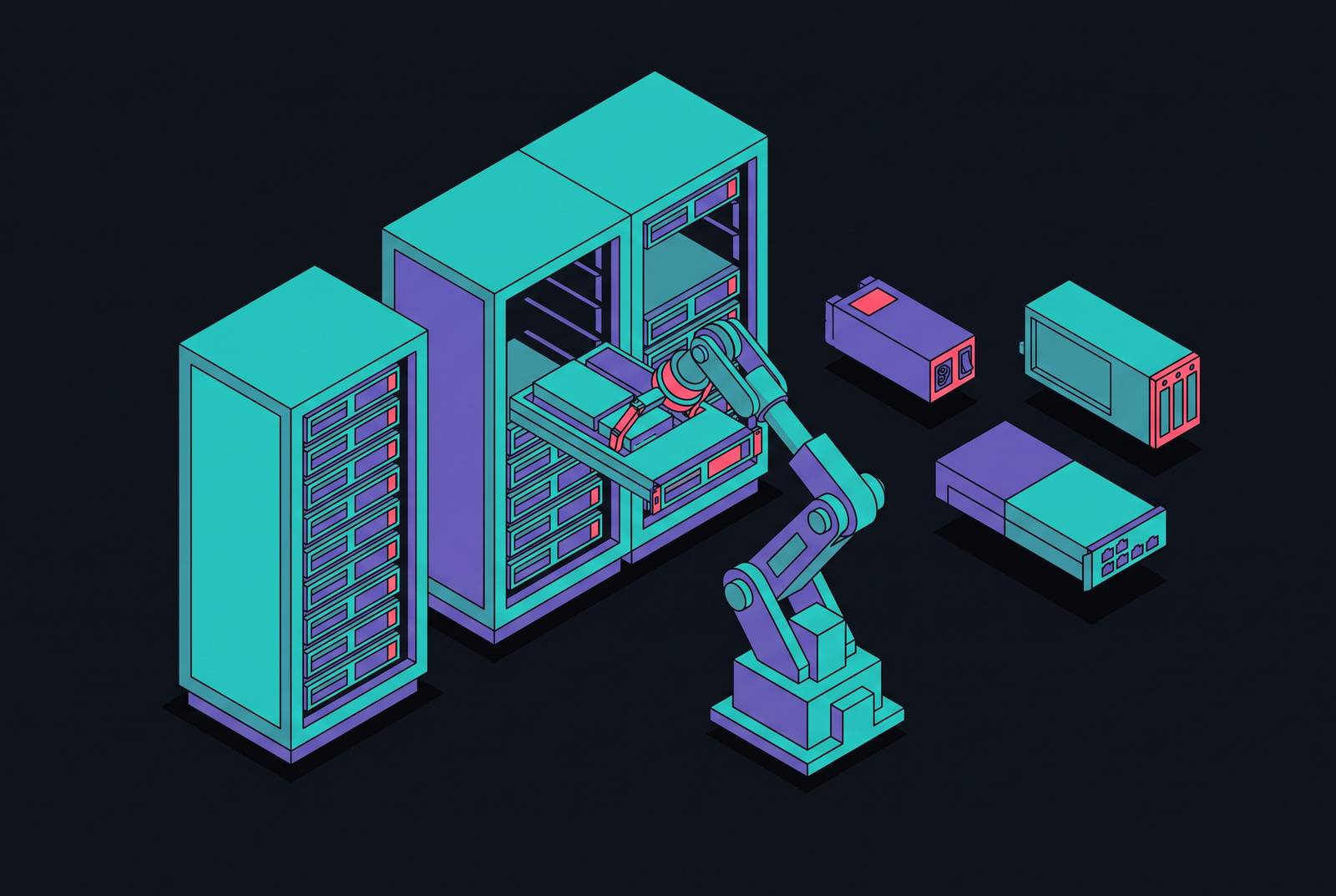
Break that into the tasks vendors are actually building for, and the difficulty compounds fast. A cable pull means gripping a connector body without tugging on the cables next to it, finding the locking tab by feel or by sight, then reseating the replacement until it clicks. Transceiver work is worse: the gripper has to slide between tightly packed optical cables, nudge them aside without disturbing their seating, then grab a small pull tab to extract or insert the transceiver itself. Microsoft Research published a paper on exactly this problem, "Robust Optical Transceiver Manipulation in Cluttered Cable Environments Using 3D Scene Understanding and Planning," because cluttered cabling is one of the genuinely unsolved problems in the field. Component reseating needs enough force to seat a card properly without cracking the board sitting next to it. Power cycling sounds trivial until you consider what it actually requires: finding a physical button or breaker on an unresponsive server and hitting it correctly the first time, in a room where every rack looks like the last one.
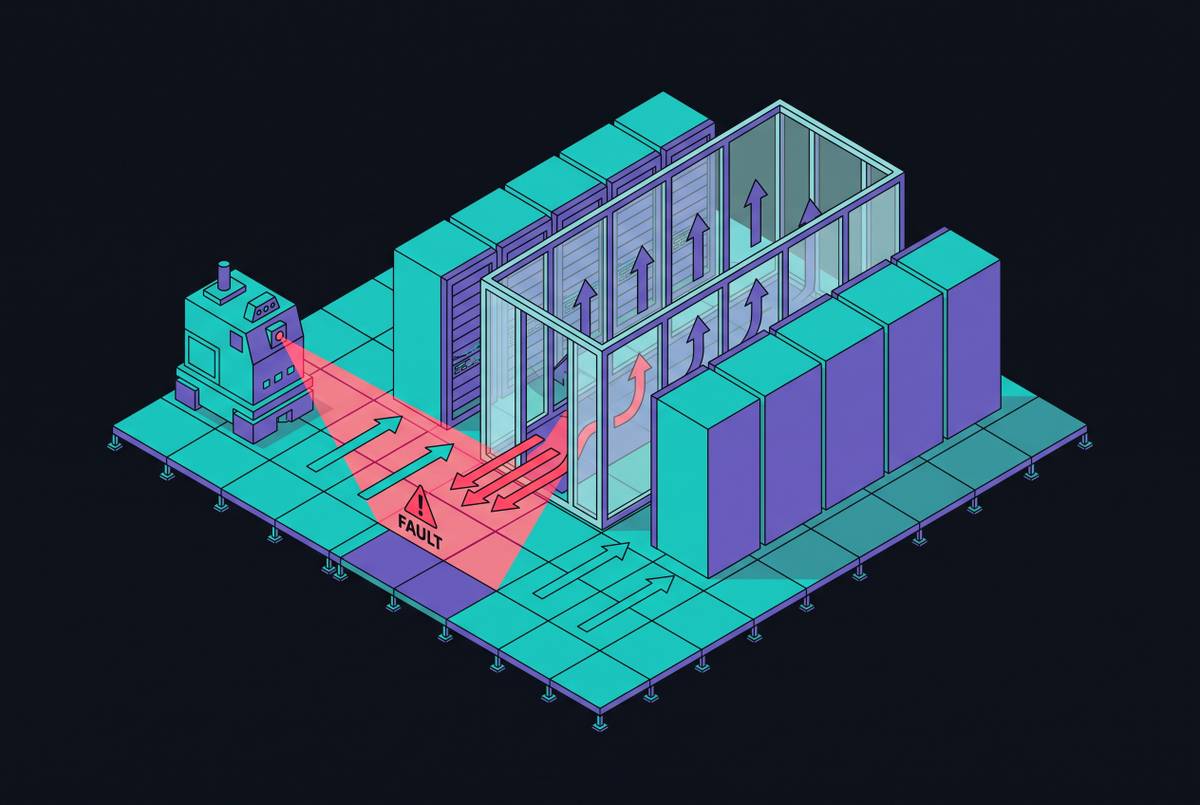
Each of these fails differently. Dense cable runs create visual occlusion severe enough that cameras can't tell one cable from the next. Server rooms are not clean, structured environments: floor cables, doors, tight aisle corners, and racks that vary row to row all break navigation routines that work fine in a lab. Indicator lights are their own problem, since grayscale cameras cannot tell red apart from green, an issue Meta's own inventory robot has already run into. The cabling on newer AI systems runs considerably denser than a standard rack, which raises the difficulty floor for every deployment built after this generation of hardware shipped.
None of this is a new idea, either. CenturyLink's US Patent 9,597,801 describes a hardware management robot that navigates to failed equipment and swaps it from a spare parts repository, and that patent has existed for years. The concept was never the hard part. Execution was, and still is.
Meta's three-vendor pilot: what each robot is doing
Meta is running three separate pilots at once, from three separate vendors, across two campuses, and no single robot in the mix handles more than one class of task. That fragmentation is itself a tell: Meta hasn't found a platform it trusts to generalize, so it's testing narrow tools narrowly, and that caution is the correct instinct even if it slows the headline numbers.
Watney Robotics, a San Francisco startup, has had two dual-armed robots working cabling tasks at Meta's Altoona, Iowa campus since June 2025. Their job stays narrow: unplugging and replacing network cables between servers. They work under human supervision, and they're slower than the technicians they're meant to eventually assist.
ABB, the Swedish-Swiss automation giant, is testing a different form factor entirely at Meta's Prometheus campus in New Albany, Ohio, the company's newest build. ABB's robot is a four-wheeled platform with a scissor-lift riser and a six-axis arm mounted on top, built to reseat hardware components inside the rack itself. That program is still in evaluation, with no deployment timeline announced.
Kinova, the Canadian robotic arm specialist known for its Gen3 platform, is working the same pilot set on power cycling: cutting and restoring electricity to a server that's stopped responding, so it reboots without a technician walking the floor to find it. That task, too, sits in evaluation rather than live deployment.
Current limits that keep these systems supervised rather than autonomous
Speed is the most obvious gap, and it's an uncomfortable one. Every robot Meta has tested so far runs slower at its assigned task than a human technician doing the same job, the exact opposite of what automation is supposed to deliver on day one.
Uptime is the subtler issue, and arguably the more stubborn one. Workers at Meta have reported that autonomous versions of these robots spend too much time recharging and not enough time working, a throughput problem that has nothing to do with dexterity and everything to do with battery design and duty cycles. Navigation still breaks on edge cases a human walks past without noticing: floor cables, doors between rooms, tight aisle corners, transitions from one building to another. All of it currently needs a person standing by to step in.
Then there's vision, which should worry vendors more than dexterity does, because the problem is a hardware limitation. Grayscale cameras can't tell a red status light from a green one, and until that's fixed, automated visual inspection of rack health stays out of reach. That constraint appears to cut across the vendor landscape, not just one platform.
Microsoft Research's modular approach and its rejection of the humanoid form factor
Microsoft has taken a position most companies chasing robotics haven't been willing to state outright: the humanoid form, or a hand-shaped gripper, doesn't fit most data center work, and building toward one wastes engineering effort that could go toward the actual problem. Instead of one general-purpose robot, its research groups are building what the company calls "advanced modular" robots, each built for a narrow, specific job.
The scope, though, runs broader than any single task. Microsoft's framework aims to cover the entire hardware lifecycle, from initial rack assembly and deployment through ongoing maintenance, repair, decommissioning, and reconfiguration. Two prototypes have come out of that work so far. One handles transceiver manipulation specifically: it uses a vision system to read the cluttered cabling in front of it, inserts its gripper between optical cables, gently parts them, and grips the transceiver's pull tab to unplug, reseat, or insert it without knocking the neighboring cables loose. The other is a fiber and transceiver cleaning robot, which inspects connector end-faces, cleans them, and reassembles the pieces in minutes.
The research behind the transceiver robot published in May 2025, under the title "Robust Optical Transceiver Manipulation in Cluttered Cable Environments Using 3D Scene Understanding and Planning." Publishing that work openly shows Microsoft is treating this as a shared engineering problem.
SoftBank's hardware-first bet: redesigning the rack so robots can handle it
SoftBank starts from a different diagnosis, and it's the most defensible one of the three. The obstacle to data center automation was always the rack, since cable density inside a standard server rack resists robotic access no matter how good the gripper gets. It's the rack. Cable density inside a standard server rack resists robotic access no matter how good the gripper gets, so chasing dexterity means chasing the wrong variable.
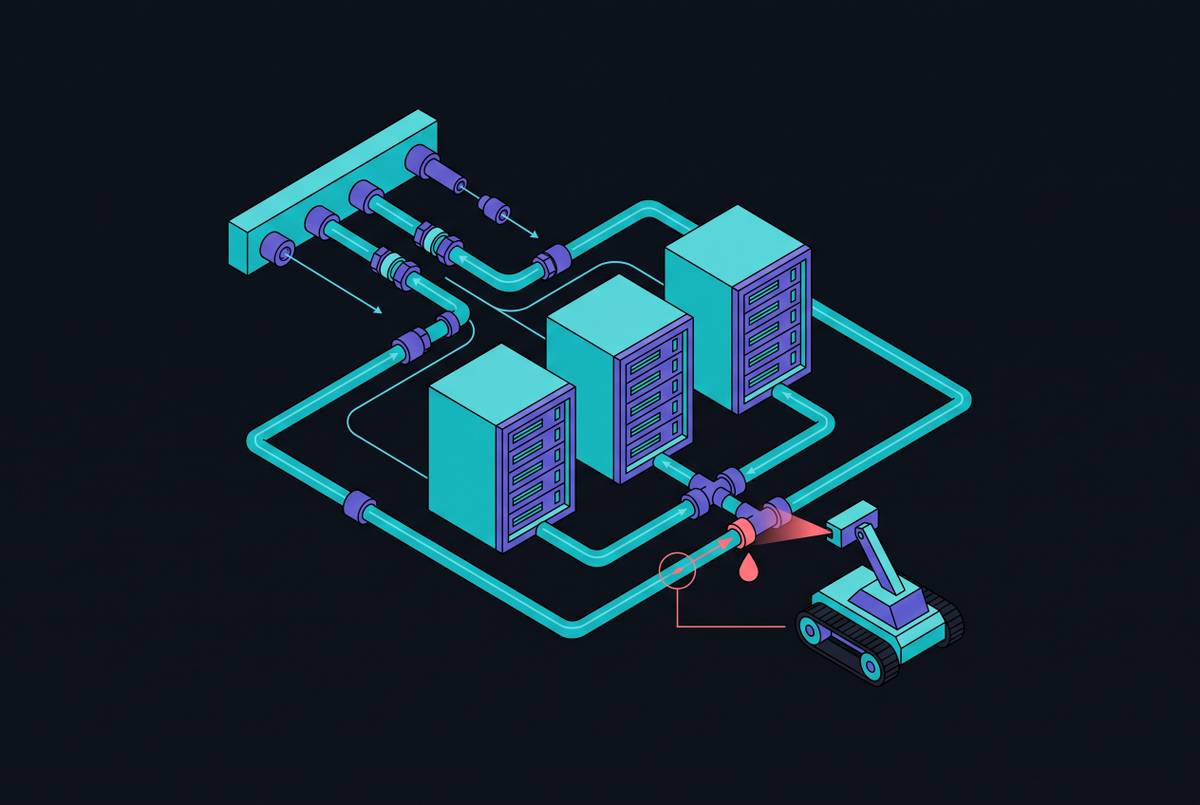
So instead of building a better gripper, SoftBank is redesigning the rack itself. The new design uses a cableless architecture built around three components. A dedicated power delivery system runs through the rear of the rack. A blind-mate connector handles water cooling. An optical connector carries communication. Put together, a server can be installed or removed without manual cable routing and without gripper threading between fiber runs.
Robots come second in this plan, not first. SoftBank, working with partner companies, is developing Autonomous Mobile Robots and Automated Guided Forklifts built specifically to work with this new rack architecture. Both are slated for deployment at the Hokkaido Tomakomai AI Data Center, scheduled to begin operating in fiscal 2026. The logic holds up cleanly: if the environment no longer demands human-level dexterity, the robot's job gets radically simpler, and simpler is what's shipping fastest right now.
Three different philosophies, one underlying problem
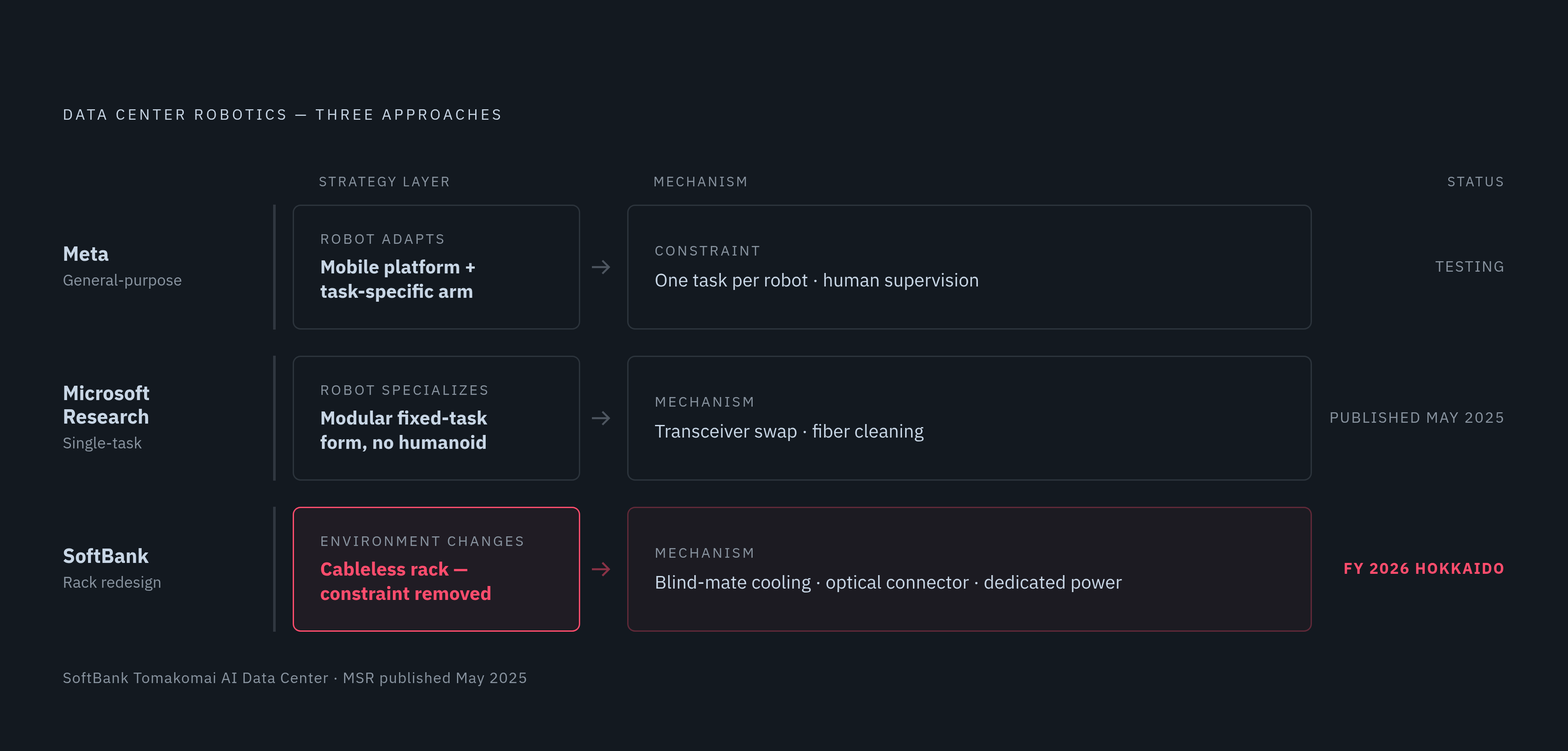
Lined up next to each other, the three approaches reveal real disagreement, not just style differences. Meta deploys general-purpose mobile platforms fitted with task-specific arms, testing each one under human supervision at live facilities, improving through iteration. Microsoft Research has moved away from general-purpose form factors, building modular robots for individual tasks and publishing its findings for the field to build on. SoftBank has chosen to redesign the rack itself, changing the physical environment to reduce the dexterity demands placed on any robot working inside it.
Of the three, SoftBank's bet looks the most structurally sound, and Meta's looks the most exposed. Asking a general-purpose arm to solve a cluttered-cabling problem that Microsoft's own research paper addresses as a genuine engineering challenge means signing up for years of incremental gains against a rack that was never designed to be touched by a machine. SoftBank sidesteps that fight by changing what the rack demands.
Even so, the three programs share more than their differences suggest. None of them treats the data center as a fixed space robots must simply learn to survive. Each treats it as a system, one where the humans, the robots, and the physical infrastructure itself stay open to redesign at once. That shared premise means the industry has stopped asking robots to adapt to a hostile environment and started asking whether the environment needs to change instead.
The money behind this makes the bet easy to understand, even with the payoff still unproven. Meta's own capital expenditures, including principal payments on finance leases, hit $31.08 billion in a single quarter of fiscal 2026, with a full-year capex outlook between $130 billion and $145 billion. At that scale, even a marginal efficiency gain per rack justifies a serious robotics research budget, because the alternative is hiring technicians in a labor market that's already short by a widening margin.
The market seems to agree on direction, if not on timing. Estimates for the data center robotics market vary by research house, but one projection puts it at $13.7 billion in 2024, growing to $44.2 billion by 2030 at a 21.6% compound annual growth rate. That spread across forecasts suggests analysts agree the trend is real and disagree only on how fast it arrives.
Where these deployments are likely to move next
What matters is whether any operator moves a single one of these pilots from supervised operation to something closer to unattended, at production scale, inside a live facility. That's the line separating a demo from a deployment, and none of the three programs described here has crossed it yet.
Watch the battery and uptime issue closely. It may prove more stubborn than the dexterity problem that gets most of the attention, since a robot that reseats a transceiver perfectly but spends half its shift charging is just a slower, more expensive substitute for a technician, not a replacement. Watch too for whether SoftBank's cableless rack architecture spreads beyond its initial deployment, since a rack redesign that only works at one facility solves nothing at industry scale. And watch whether Microsoft's modular, single-task robots move from prototype and research stages into sustained maintenance work at live facilities.
The staffing numbers aren't going to reverse on their own. Data centers keep multiplying, AI capex keeps climbing, and the pool of qualified technicians isn't growing anywhere near as fast as the racks that need servicing. Robotic arms won't close that gap by pretending to be humanoid generalists, and the vendors still chasing that shape are burning time on the wrong problem. They'll close it, if they close it at all, by doing one job at a time, reliably, inside racks built to let them succeed.
Sources
- Meta data centre robots: cable swaps and server resets
- Meta is testing robot arms inside data centers that could replace up to 80% of human workload
- Meta is testing robot arms inside data centers that could replace up to 80% of human workload
- Meta Is Testing Robots to Take Over Data Center Grunt Work - Startup Fortune
- 9597801
- Meta Data Center Robots Expose Two-Stage Automation Squeeze on Skilled Technicians
- datacenterdynamics.com
- datacenterdynamics.com